













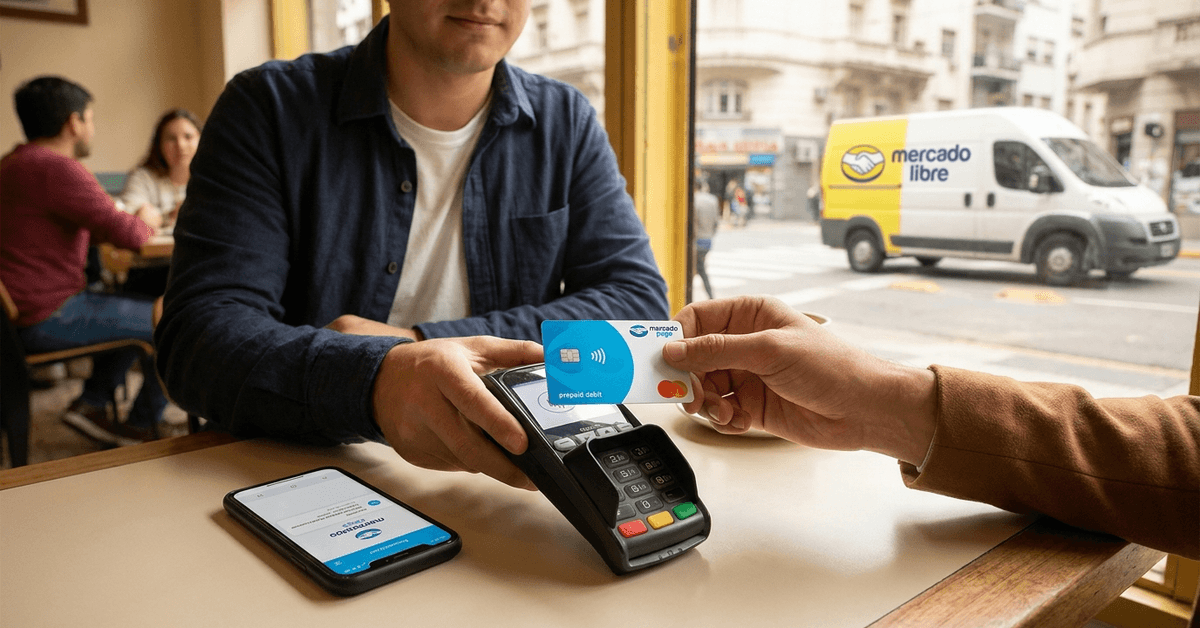
Mercado Pago will ship you a prepaid Mastercard for free. No issuance fee, no annual charge. The card arrives in 5 to 15 business days depending on where you live in Latin America.
But the card itself isn't the bottleneck. The verification level on your Mercado Pago account determines how much you can spend, withdraw, and transfer. A card attached to an unverified account has limits so tight it barely covers a week of groceries.


This matters most if you freelance through Mercado Libre or run a side hustle that pays into your Mercado Pago wallet. The money hits your account, and the card is supposed to let you spend it.
The Verification Bottleneck That Controls Your Card
The request process for a Mercado Pago prepaid card takes about three taps inside the app. That part is easy. The part that trips people up happens either before or after those three taps, depending on the country.
Mercado Pago ties every card function to your account's verification tier. An unverified account can receive small payments and make basic purchases. A fully verified account unlocks higher transaction ceilings, ATM access, and the ability to transfer larger sums to bank accounts.
The difference between the two tiers can mean the difference between a $200 monthly spending cap and something that covers real daily expenses.
What Mercado Pago Requires for Full Verification
The documents vary by country, but the general pattern holds across Argentina, Brazil, Mexico, Chile, Colombia, Peru, and Uruguay:
- A national ID number or taxpayer identification (DNI in Argentina, CPF in Brazil, RFC/CURP in Mexico)
- A selfie or liveness check through the app's camera
- Personal data matching your government records, including legal name and date of birth
Some users report that verification takes minutes. Others describe delays of several days when the app's automated checks flag a mismatch between submitted photos and government databases.
I'd argue the smartest move for anyone planning to request the card is to complete verification first. Waiting until after the card arrives creates an awkward window where you have plastic in hand but can't do much with it.
Age and Residency Rules Worth Checking
The minimum age is 18 in most Mercado Pago markets. Residency requirements depend on the country. A foreign passport alone won't always work.
Argentine accounts, for example, typically require a DNI or CUIL, which means non-residents may need to look elsewhere unless they have local tax identification.
Mexico tends to accept CURP, and Brazil requires a CPF. The pattern: local tax identity is the real gatekeeper, not just age.
Step-by-Step: Requesting a Mercado Pago Card Through the App
Once verification is squared away, the card request itself is almost anticlimactic. The process runs entirely through the Mercado Pago mobile app, and the steps look nearly identical across countries with minor label differences.
Open the Mercado Pago app and look for the "Tarjetas" or "Cards" tab in the main menu. If you don't see it, update the app. Mercado Pago pushes frequent updates, and older versions sometimes hide newer features.
Tap "Request Card" or the equivalent in your language. The app checks your verification status at this point. If something is missing, it redirects you to complete that step first. If everything checks out, you confirm your shipping address and accept the terms.
The physical card ships to your registered address. Delivery windows range from 5 to 15 business days, though urban areas in Brazil, Argentina, and Mexico tend to land on the shorter end of that range.
Activating the Card After It Arrives
The card shows up in a sealed envelope with a QR code or activation code printed inside. Open the Mercado Pago app, go back to the Cards section, and scan the code or enter it manually. Activation usually happens instantly.
One small frustration that catches people off guard: typos in the activation code. The codes include letters and numbers that look similar on print (I vs 1, O vs 0).
If activation fails on the first try, double-check each character against the printed code before contacting support.
Virtual Card Option
Mercado Pago also issues a virtual card that loads into your app immediately after approval. This works for online purchases right away, even before the physical card arrives.
I think the virtual card alone would suit anyone whose spending is mostly online subscriptions and Mercado Libre purchases, since the physical card adds convenience only for in-person payments and ATM withdrawals.
Fees and Limits on the Mercado Pago Prepaid Card
The card has no issuance fee and no maintenance fee. That part is straightforward. The fees that matter are transactional, and they shift by country and account tier.
ATM Withdrawal Costs
ATM withdrawals carry a per-transaction fee in most Mercado Pago markets. The exact amount varies, but users in Argentina and Mexico consistently report small charges per withdrawal. These fees come on top of any fee the ATM operator itself charges. If your plan is to use the Mercado Pago card as your primary cash source, those per-withdrawal charges stack up fast across a month of regular use.
The card works best as a spending and receiving tool for Mercado Libre income, not as your only financial relationship.
How Transaction Limits Scale:
| Feature | Unverified Account | Fully Verified Account |
|---|---|---|
| Monthly spending limit | Low (varies by country) | Significantly higher ceiling |
| ATM withdrawals | May be restricted or unavailable | Available with per-transaction fee |
| Transfers to bank accounts | Limited or blocked | Active with standard processing time |
| Card network | Mastercard (some regions Visa) | Mastercard (some regions Visa) |
| Card issuance fee | Free | Free |
The takeaway: verification isn't optional if you want the card to function as anything more than a novelty.
Mercado Pago Card vs Payoneer and Wise for Latin American Freelancers
If you earn money online and live in Latin America, the Mercado Pago card competes with two other prepaid options: Payoneer and Wise. The comparison depends almost entirely on where your money comes from and what currency you need to spend.
Where Mercado Pago Has an Edge
Mercado Pago's biggest advantage is its direct integration with Mercado Libre.
Sellers who receive payouts from the marketplace can spend that money through the prepaid card without transferring it to a separate bank account. That loop, earning on Mercado Libre and spending through Mercado Pago, skips one transfer step and one waiting period.
The app also supports:
- Bill payments directly from your balance (utilities, mobile top-ups, municipal services)
- QR code payments at physical stores in participating countries
- Peer-to-peer transfers to other Mercado Pago users at no fee
- Daily interest on account balances in some markets, notably Argentina and Brazil
Where Payoneer or Wise Might Make More Sense
Payoneer and Wise cards both handle multi-currency receiving and spending better than Mercado Pago. If clients pay you in USD or EUR, converting that to local currency through Mercado Pago means going through extra steps and potentially worse exchange rates compared to Wise's mid-market rate conversions.
Payoneer's card lets you hold multiple currencies in one account and withdraw in local currency at ATMs worldwide. Wise does the same with transparent conversion fees. Mercado Pago's card operates in your local currency only. No multi-currency wallet. No mid-market rate engine.
For a freelancer whose income arrives in local pesos or reais through Mercado Libre, the Mercado Pago card keeps things simple. For someone receiving international client payments in USD, Payoneer or Wise cuts fewer corners.
Everyday Uses and Limitations to Know About
The Mercado Pago prepaid card works wherever Mastercard (or Visa, depending on your market) is accepted. That covers supermarkets, gas stations, online retailers, and most subscription services like Netflix or Spotify.
A few practical limits to keep in mind:
- No credit history building: This is a prepaid card, not a credit card. It does not report to local credit bureaus in Argentina, Brazil, or Mexico. If building a credit score is part of your financial plan, this card contributes nothing toward that goal.
- International purchases may trigger blocks: Some users report that Mercado Pago's fraud detection flags purchases from foreign merchants or services billed in USD. Unlocking these transactions sometimes requires contacting support through the app's chat.
- Balance dependency: The card only works when your Mercado Pago wallet has funds. No overdraft. No grace period. If the balance hits zero, the card declines.
Troubleshooting Common Card Problems
Delivery delays are the most frequent complaint. The app includes a tracking feature for the physical card. If delivery exceeds 15 business days, the in-app chat support can initiate a reshipment.
Card activation failures almost always trace back to code entry errors, so checking character by character before requesting a replacement saves time.
Lost or stolen cards can be frozen instantly through the app's security menu. The balance stays safe. A replacement card request follows the same process as the original.
Questions People Ask About the Mercado Pago Card
These are the questions that keep showing up in forums and app store reviews, answered without the usual runaround.
- Q: Can I use the Mercado Pago card outside my country? The card runs on Mastercard's or Visa's network, so it technically works at international terminals. But Mercado Pago's terms in some countries restrict cross-border transactions, and conversion rates are set by Mercado Pago rather than the card network. Check your country's specific terms before relying on it abroad.
- Q: Does the Mercado Pago card charge a monthly fee? No monthly maintenance fee exists as of 2026. The costs come from individual ATM withdrawals and, in some markets, certain transfer types. The card itself stays free to hold.
- Q: How fast can I get the virtual card after signing up? The virtual card typically appears in your app within minutes of account verification approval. Physical card delivery is a separate timeline. If online spending is your priority, the virtual card fills that gap immediately.
Conclusion
The Mercado Pago card fills a specific gap for freelancers and sellers tied to Latin America's largest marketplace. Treating it as a spending extension of Mercado Libre income makes the most sense for daily use.
The verification step deserves more attention than the card request itself, since limits and access depend on it entirely.
Pair it with a proper bank account for credit building and international needs, and it slots into a financial setup without pretending to replace one.